
Documents
To work directly from a local or remote folder (OneDrive, SharePoint, Dropbox, tags, etc.) inside a conversation, see Workspaces.
Import and Management of Your Documents
You can import, organize, and edit your documents directly in Ordalie. Imported documents are automatically indexed and become usable in conversations and workflows.
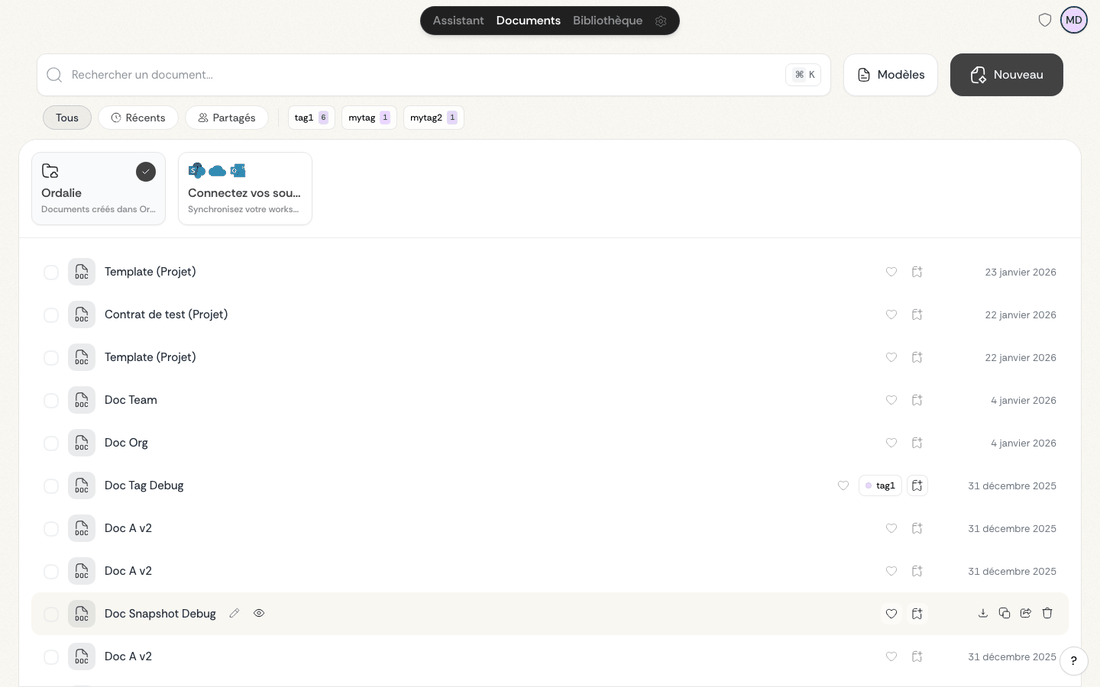
Multi-Format Import with Drag-and-Drop
Two import methods are available:
Import by Navigation: Click the Import Documents button in the Documents section to open the file selector and choose your documents from your computer.
Import by Drag-and-Drop: Drag your files directly from the file explorer to the Ordalie interface. The system automatically recognizes the content and displays immediate visual feedback during the operation.
Supported Formats: PDF, DOC, DOCX, TXT, MD, PowerPoint (PPTX), and Excel (XLSX/XLS). PowerPoint presentations preserve slide structure, and Excel files preserve table organization.
Automatic Anonymization: During import, you have the option to activate automatic anonymization of your documents. This function replaces sensitive information (names, addresses, phone numbers) with generic data, thus preserving confidentiality while maintaining document structure.
Once imported, documents are automatically indexed and become searchable via search.
Confidentiality 🔒: All your documents remain strictly private and secure. They are never shared with other users without your explicit authorization and remain under your complete control.
Hierarchical Tag Organization System
Documents are organized by tags rather than folders. A single document can carry multiple tags, which avoids duplication.
Custom Tags: Create your own tags to categorize by your criteria (contract type, client, legal domain, validation status, etc.). For example, a contract can carry the tags "Business Law", "ABC Client", and "Under Review" simultaneously.
Filtering: Isolate documents carrying a specific tag, or combine multiple tags to narrow results. The search bar in the Documents section also filters by name.
Group Pinning: When working in the assistant or a workflow, you can pin all documents from a tag in a single action — useful for analyzing a complete case file without selecting files one by one.
Organizational Sharing: On PRO accounts, tags allow sharing document collections with organization members. For large-scale centralized management, see Ordalie Vault.
Automatic Descriptions: The AI analyzes the documents in a folder and generates a description summarizing its contents, making it easy to identify a folder without opening it.
Advanced Document Editor
Enriched Editing Interface
Each document opens in a built-in editor. The editor is built around the DOCX format: when you import a Word file, edit it, then export it, formatting, styles, tables, and structure are preserved identically. No formatting loss, no approximate conversion.
Rich Formatting: The editor supports all expected formatting functionalities: bold, italic, underline, bulleted and numbered lists, tables, hyperlinks, and hierarchical paragraph styles adapted to legal documents.
Legal Structure: Specialized tools allow you to structure your documents according to legal conventions, with intelligent management of articles, paragraphs, and subsections that automatically respects appropriate numbering and indentation.
Modification Tracking and Collaboration
Real-Time Collaborative Editing:
You can work with multiple people on the same document simultaneously, like in Google Docs. You will see your colleagues' changes appear instantly on screen, with each user's cursor identified by a distinct color.
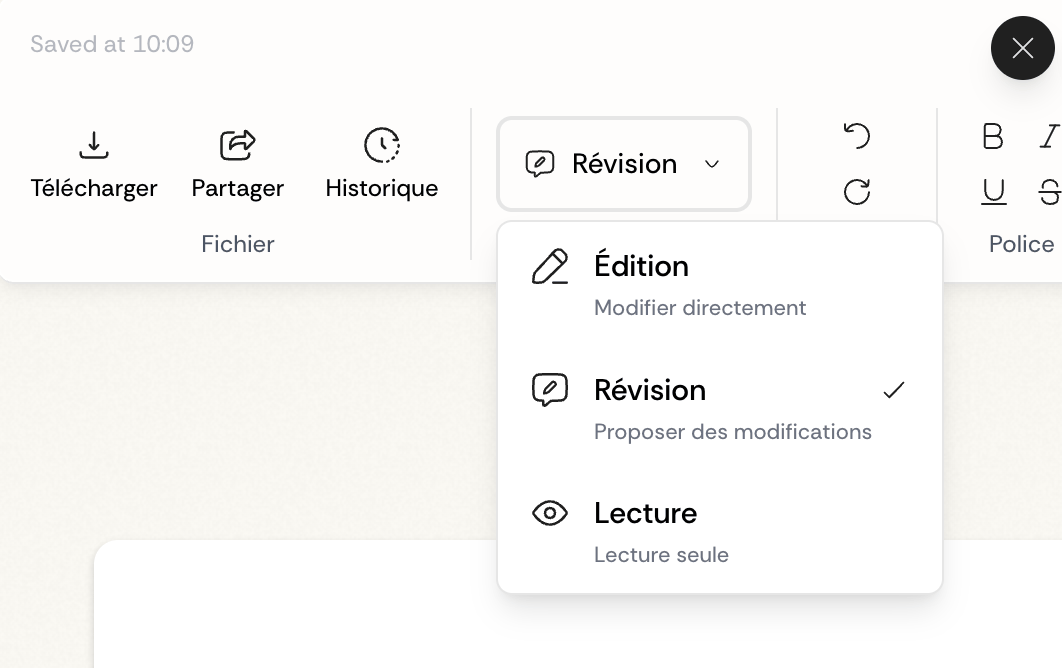
Integrated Track Changes: Ordalie offers a modification tracking system comparable to Microsoft Word's, but optimized for legal work. All modifications (additions, deletions, moves) are timestamped and attributed to their author. You can accept or reject each modification individually, and see precisely who did what and when.
To enable it, select this mode directly from the toolbar at the top of the screen:
Comment Management: The comment system allows linking observations to specific document passages. Comments support threaded replies and can be resolved once processed, creating a contextual discussion thread directly in the document.
Version History (Document Trail): Each modification is automatically saved. Click the Trail button in the toolbar (File section) to open the full history panel.
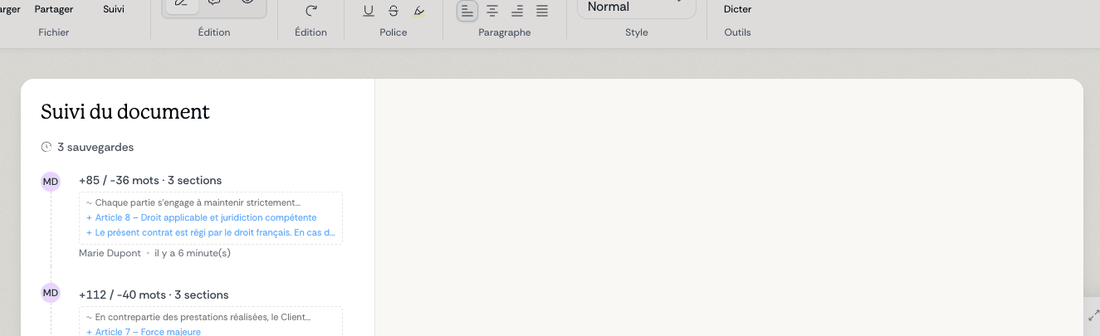
Each timeline entry shows the author, date, and a summary of changes (paragraphs added, deleted, or modified, word count). A preview of the changes is displayed directly under each entry: additions appear in blue, deletions in red, and modifications in gray.
Click a version to preview it with modified passages highlighted directly in the document. You can switch between the Modifications (diff) view and the Original view, and navigate between changes using the up/down arrows.
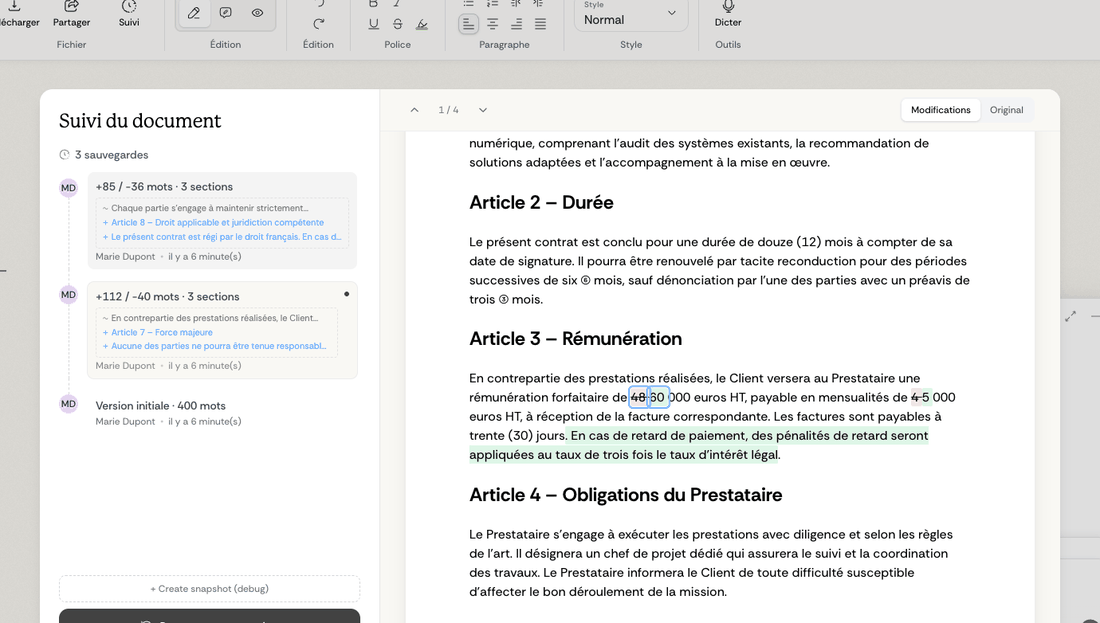
To restore a previous version, select it and click Restore this version. A backup of the current state is automatically created before any restoration. Restore and export events are also tracked in the history, forming a complete audit trail of the document's lifecycle.
Validation States: Track the validation status of your documents with clear visual indicators that inform you about the revision progress state.
AI Analysis and Transformation
Intelligent Document Analysis
The AI can analyze your document content in several ways:
Multi-Document Analysis: Select multiple documents simultaneously for comparative or cross-analysis. The AI identifies patterns, differences, and common elements between documents, generating structured reports according to your needs.
Key Information Extraction: Automatic analysis can extract stakeholders, important dates, contractual obligations, sensitive clauses, and other critical elements from your documents, organizing them into easily exploitable tables.
Predefined Analyses: Ordalie offers ready-to-use analysis templates for the most frequent use cases: executive summary, risk identification, commitment extraction, event timeline.
Custom Analyses: Create your own analysis templates by defining specific questions you wish to regularly ask your documents. These templates can be saved and reused to maintain consistency in your analysis processes.
Document Generation and Transformation
AI-Assisted Generation: Ordalie can generate entire documents from your instructions, using your reference documents as a base. Whether creating contracts, letters, conclusions, or memos, the AI relies on your style and existing templates.
Intelligent Transformation: Automatically transform your existing documents according to new criteria: perspective change (buyer to seller), adaptation to a new legal context, update according to new regulations.
Contextual Rewriting: Select any portion of text in the editor to trigger rewriting options: fluidity improvement, style adaptation, technicality level modification, or application of specific instructions.
Export and Sharing
Professional Export Formats
Two export formats are available:
PDF Export: High-quality PDF generation with preservation of formatting, internal links, and metadata. PDFs can include or exclude comments according to your needs.
DOCX Export: Export to Microsoft Word with complete preservation of structure, formatting, and advanced features like automatic tables of contents and cross-references.
Export Anonymization: During export, you can choose to apply automatic anonymization that replaces sensitive information while preserving document structure and readability.
Confidentiality Management
Granular Access Control: For organization accounts, define precisely who can access, modify, or comment on each document according to flexible authorization levels.
Reinforced Security: Communications between your browser and our servers are encrypted via HTTPS and documents are stored securely on our infrastructure.